Custom vinyl stickers for equipment, cases, and gear used outdoors. They are waterproof, but outdoor life depends on sun, weather, and surface, so tell us how they will be used before ordering.
Every order is printed from the artwork you upload, in the size, finish, and quantity you choose, with a digital proof before production.
Your print-ready proof will arrive within 24 hours. Review it carefully so production can proceed.
Helpful Details Before You Order
Design Tips
Prepare artwork at 300 DPI at the final print size.
Use CMYK color mode when possible. Screen color can differ slightly from printed color.
Keep small text, fine lines, borders and narrow cut areas thick enough to print and apply cleanly.
Review spelling, scale, color, border and cut shape carefully on the digital proof.
Artwork & Digital Proof
Upload one design using the highest-quality file available. We check print readiness and send a digital proof before production begins.
Free Shipping
Free shipping is available. Delivery timing begins after proof approval and production. Review our shipping policy.
Return Policy
This item is custom-made. If it arrives defective, damaged, incorrect, missing or materially different from the approved proof, review our Return & Refund Policy for eligibility and next steps.
Application planning
Start with the gear—not the word “outdoor.”
A bottle, powder-coated case and flexible helmet can behave differently even in the same environment. Match the construction to the exact surface, curve and cleaning routine, then validate a finished sample.
Build a sticker for bottles, helmets, cases and equipment while treating surface, curvature and exposure as separate checks.
✓
Before productionIf any condition is unknown, sample-test the finished sticker on the real surface.
01
Best for
Smooth bottles, helmets, cases, signs and outdoor equipment
02
Surface
Clean, dry, smooth metal and compatible coated plastics
03
Exposure
Rain, outdoor light and regular handling
04
Test first
Textured, low-energy, freshly painted or flexible surfaces; confirm edge lift and removal expectations
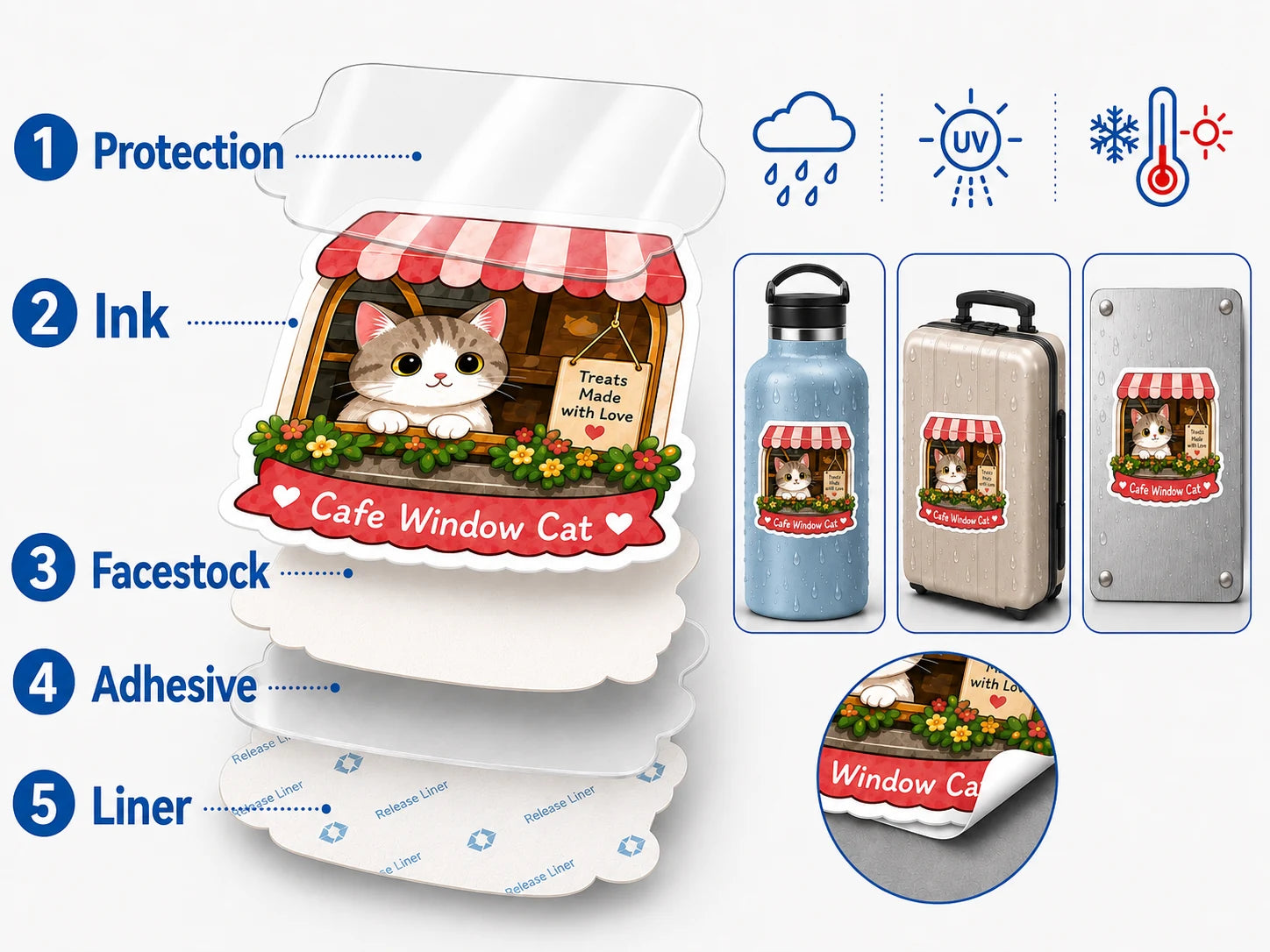
Complete sticker construction
Five layers. One complete sticker system.
A sticker works as one construction. Review each layer’s job, then confirm the exact material codes and test the finished build on the real surface.
Layers are separated for clarity and are not shown to scale. In production they work as one finished construction.
01
FacestockDimensionally stable, conformable exterior-oriented vinyl film candidate.
Why this choice
Outdoor gear combines curves, temperature movement and edge exposure, so the face should remain flexible without excessive shrinkage.
02
AdhesiveHigher-tack, water-resistant acrylic candidate matched to the exact metal, paint or plastic surface energy.
Why this choice
Rain alone does not determine adhesion; wet-out, application temperature, curve stress and low-energy plastics control edge lift.
03
InkExposure-appropriate CMYK ink system with defined cure and color requirements.
Why this choice
Sunlight, moisture and temperature can shift color or weaken print, so the actual ink and cure must support the declared exposure.
04
ProtectionUV-, water- and abrasion-oriented overlaminate candidate.
Why this choice
A laminate shields the printed layer from light, cleaning and repeated handling, but does not make every construction waterproof or dishwasher-safe.
05
Liner & applicationStable release liner suited to die cutting and controlled application on curved gear.
Why this choice
Predictable release helps placement without stretching the sticker, trapping contamination or creating early edge stress.
Engineering boundary: these are use-case-specific starting directions, not finished supplier specifications or unconditional performance claims. Confirm the exact facestock, adhesive, ink, protection and liner codes, then validate the finished construction on the real surface when the application is unfamiliar or demanding.
Common uses for Adesivi per Esterni
See where this product fits—and where to test first.
Use these examples as practical starting points. The exact surface, shape, exposure and service period still determine whether a finished sample should be tested.
Bottles & drinkware
Best on clean smooth compatible finishes; keep clear of drinking edges and confirm washing expectations.
Helmets & protective gear
Use only on decorative areas permitted by the equipment maker; never cover vents, labels or safety-critical zones.
Hard cases & equipment
Smooth rigid panels are the clearest starting point; texture, oils and flexible panels need a finished-sample test.
Signs & trail gear
Confirm the mounting surface, viewing life and cleaning method; outdoor exposure never replaces edge-lift testing.
Why Inkelligent
A clearer path from artwork to application.
Custom stickers are easier to order when the artwork, material direction and production approval are handled as one connected process.
Proof before production
Review the artwork, scale, cut shape and visible details on a digital proof before the order moves into production.
Practical guidance
Use the surface, shape, exposure and service period to identify a sensible starting construction instead of relying on one material name.
Clear testing boundaries
When a surface or condition is unfamiliar, we identify what still needs confirmation rather than presenting an unconditional performance promise.
From artwork to production
A clear four-step order path.
01
Choose
Select size, finish and quantity for the real application.
02
Upload
Add print-ready artwork or the best file you currently have.
03
Review
Check the digital proof carefully before production begins.
04
Print & ship
Your approved order is produced and shipped to you.
Before you approve
Useful checks, without the guesswork.
Use these answers to identify what should be confirmed in the proof or a physical sample.
Will this stick to every surface?
No adhesive is universal. Cleanliness, coating, texture, surface energy, curvature and dwell time can change the result. Test the exact surface when any of these are unknown.
What does gloss versus matte change?
Finish changes appearance, glare and surface feel. It may also influence scuff visibility and handling, so choose in the context of the artwork, lighting and use conditions.
Does “outdoor” mean every surface and weather condition?
No. Outdoor use adds light, moisture, temperature and handling variables, while the substrate still controls adhesion. Record the actual surface and exposure, then validate the finished sample.
When should I request extra guidance?
Ask before production when the surface is unknown, textured, coated, tightly curved, exposed to chemicals, safety-critical or expected to remove cleanly after a long dwell.
Need a different starting point?
Match the use conditions first—or compare every product.